

Facial peeling with lactic acid at home: recipes for how to make milk peeling
Peeling with lactic acid at home is a fairly common procedure, because with its help you can exfoliate the keratinized layer of the skin and nourish it well with useful substances, increase elasticity, tighten and even smooth out fine wrinkles.
Useful properties of lactic acid
Milk peeling at home is one of the safest and most beneficial procedures aimed at removing dead skin cells. This manipulation is a superficial chemical peel. The active substance of the cosmetic product, which is applied to the face, is lactic acid, which belongs to the number of alpha acids. This substance has the following beneficial properties for the skin:
1 Has a powerful antimicrobial and anti-inflammatory effect.
2 Deeply cleanses, tightens and whitens the skin
3 Visibly smoothes fine wrinkles, rejuvenates.
4 Fights skin rashes in the form of acne and blackheads, prevents their reappearance.
5 Normalizes the activity of the sebaceous glands.
6 Stimulates the production of your own collagen.
Surely, many of the women and girls applied sour cream, kefir or yogurt to their faces for skin care. In fact, such procedures can be considered a simple milk peeling for the face at home.
Carrying out the procedure of milk peeling
Before peeling the face with lactic acid at home, it is necessary to thoroughly cleanse the skin with lotion, and then wipe it with alcohol to completely remove sebum. For the facial skin care procedure, the following recipe for lactic acid peeling at home is most often used. For the procedure, you will need the following tools:
- lactic acid solution – the concentration of this substance is in the range of 30–70%, for the first time it is better to use 30% acid, increasing its concentration with each procedure;
- medical alcohol;
- cotton pads.
To make milk peeling at home, follow these simple steps:
1 On previously cleansed and well-dried skin, apply lactic acid with a cotton pad. It should be moist, and there should not be too much solution on it, as dripping liquid can get on the eyes and other mucous membranes. With a wet disk, wipe the face well, avoiding the areas around the lips and eyes, otherwise irritation will occur.
2 Leave lactic acid on the face for 1–1.5 minutes for the first time and for 2–2.5 minutes if peeling is repeated.
3 Soak the lactic acid solution on the face for the specified time, and rinse off the remnants of the product with cold water.
4 At the end of the procedure, apply a light moisturizer to the skin.
Despite the beneficial effect on the skin, there are some contraindications to this cosmetic procedure. Peeling with lactic acid has the following contraindications:
- pustular and inflammatory rashes on the skin, any wounds and injuries;
- increased sensitivity of the skin of the face;
- herpes at the stage of exacerbation;
- the period after sunburn, depilation;
- pregnancy and lactation;
- age up to 18 years.
With the formation of spider veins on the face, the concentration of lactic acid should be minimal – no more than 30%.
Tips of cosmetologists for the procedure of milk peeling
Considering some recommendations of specialists in the field of cosmetology, you can avoid difficulties and complications during peeling at home. Cosmetologists give such useful tips:
1 Carrying out the procedure, keep a hair dryer nearby, with its help it is easier for many women and girls to withstand lactic acid on their faces. As soon as you start to feel a strong burning sensation of the skin, turn on the hair dryer: using cool air, you can reduce discomfort.
2 Do not exceed the duration of the procedure, it is important to strictly observe the specified time frame. If lactic acid is kept on the face for a long time, severe chemical burns can form in the form of wounds and ulcers.
3 Do not rinse off the cleanser with hot or even warm water. Only cold water is used, otherwise such actions will lead to severe irritation on the skin.
4 To prevent the formation of inflammatory processes in the area of the lips and eyes in case of contact with the solution, pre-treat these areas with petroleum jelly or a regular greasy cream.
Experts do not recommend carrying out the procedure using lactic acid more than once every two weeks. However, in order to achieve noticeable results and see positive changes in the condition of the skin, 3 to 6 procedures should be performed, depending on the complexity of the cosmetic problem.
How to make lactic acid peeling: recipes at home
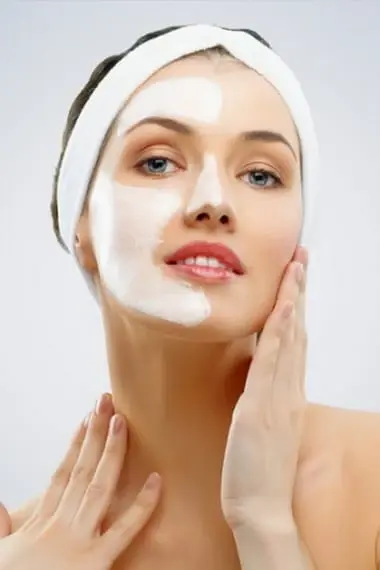 Milk peeling can also be carried out using natural products – sour cream, kefir, whey. There are many folk recipes for milk peeling at home, among which the following methods of cosmetic procedures are popular.
Recipe #1
For peeling you will need 3 tbsp. l. whey and a tablespoon of ground coffee. Combine these two components and apply to cleansed skin, rinse after 15 minutes.
Recipe #2
Combine whey with coarse sea salt in a ratio of 3:1. Mix all the components and apply on the face, soak for 10 minutes and rinse.
Recipe #3
Soak slices of rye bread in whey, crush with a fork. Apply the resulting slurry to the skin, rinse after 15 minutes with water, but first move your fingers over the face, performing massage movements.
Recipe #4
Take cottage cheese and serum in equal proportions, combine, apply on face. After 10 minutes, walk over your face with your hands in a circular motion. If the skin of the face is oily, egg white can be added to this mass.
Homemade masks based on dairy products can be applied to the face no more than twice a week.