

Haircut technology for medium hair: how to cut a bob, cascading haircut technique for medium hair
Classic haircuts with medium hair length – bob and its variants, as well as a cascade hairstyle. These haircuts are versatile and easily become the basis for evening styling.
How to cut a bob for medium hair and perform variations of this haircut, you will learn on this page. Also below is the technique of cascading haircuts and the technology for performing a romantic hairstyle.
Haircuts, in which beautifully designed medium-length hair remains, are performed in compliance with certain rules. In any, even the simplest haircut, there are subtleties that only the master knows.
Haircut technology classic bob for medium hair
1 The technology for performing a classic caret begins with moisturizing clean hair. In the process of cutting drying hair, spray it with water from a spray bottle.
2 Mentally outline the length of the hair of the finished caret. It should be remembered that after drying, straight hair rises by 1 cm.
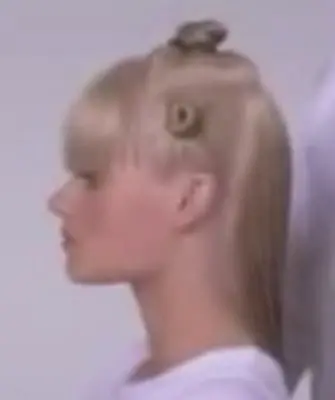
3 Divide the hair on the head with a straight parting, separate the occipital strand (about 1 cm thick) and pin the hair into 2 ponytails so that they do not interfere.
4 Trim the occipital strand, taking into account the length of the future hairstyle. The length of this strand should be guided when cutting the rest of the hair.
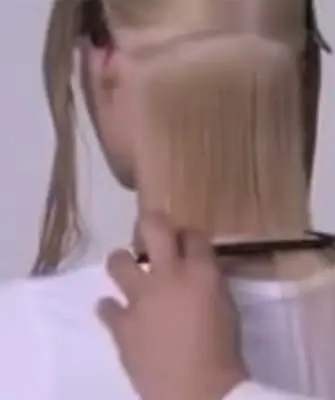
5 With a comb, make horizontal partings and separate the upstream strands of the same thickness (1 cm). Comb them onto the control strand and cut directly along it – the “strand by strand" technique. During the haircut, you can not pull the hair. Cut the strands in the direction from the center of the back of the head towards the ears, that is, first from the center of the back of the head to the left, then to the right.
6 At the temples, also separate the hair horizontally, cut it in the same way as the occipital hair. Comb the hair on the control strand without deflection and without pulling.
7 On the parietal part of the head, part the hair and comb it to the left and right. Cut them along the control strand, which is highlighted at the back of the head.
8 In the process of how to cut a classic bob, remember that it must be symmetrical. Therefore, it is necessary to ensure that the client keeps his head straight. Next, pull out the lateral (temporal) strands of hair under the chin towards each other. If the haircut is without bangs, then you can comb the side strands from the parting to the face. If they are of different lengths, then you need to straighten the hair.
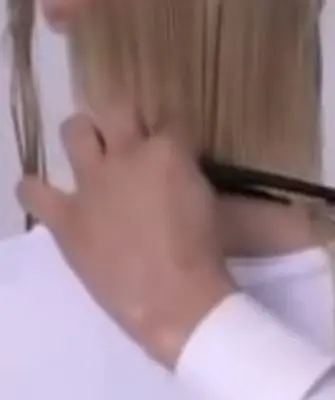
9 The symmetry of the haircut at the back is checked in the same way. The temporal and occipital strands of hair are connected at the back, in the center of the nape. All hair should be strictly the same length and have a clear outline below.
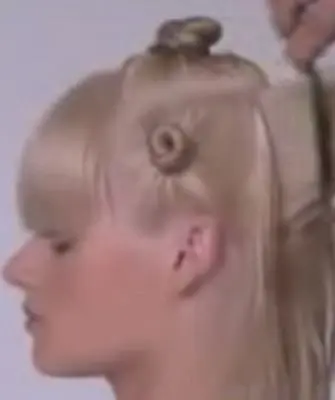
10 Edging in a classic square is carried out simultaneously with determining the length of the hair, creating a straight contour and improving the symmetry of the hairstyle. Then you should do the thinning. It is performed at a distance of 2-2.5 cm from the ends of the hair. If necessary, you can perform it at the roots of the hair. Then the hairstyle will look more voluminous.
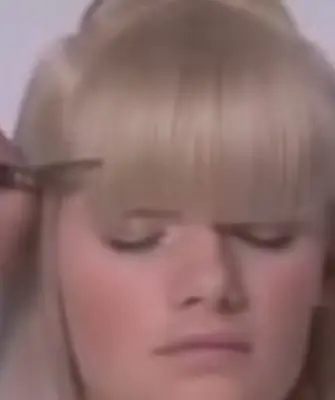
11 This haircut is beautiful on hair of any color. It covers wide cheekbones and a weakly defined chin. The classic bob haircut technology provides for mandatory hair styling with a brush and a hairdryer, then the hair will be more lush. If you twist them with curling irons or wind curlers, then the traditional hairstyle will look very profitable.
How to cut a bob with upturned ends of hair
1 Wet clean hair with water.
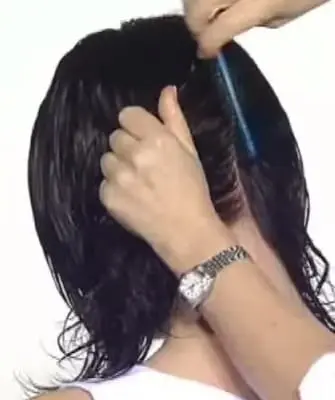
2 Separate the hair and cut it at the back of the head as in a classic bob.
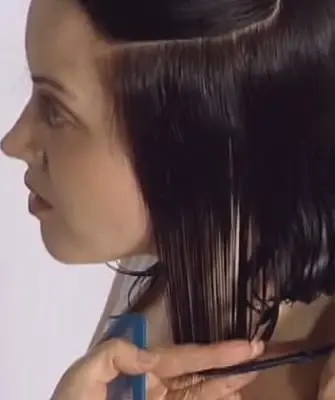
3 When starting to cut hair in the upper occipital part of the head, the hair needs to be pulled back a little (by 15 °) and cut shorter than the original occipital strand. This is not a simple stage of haircut, the final result depends on it.
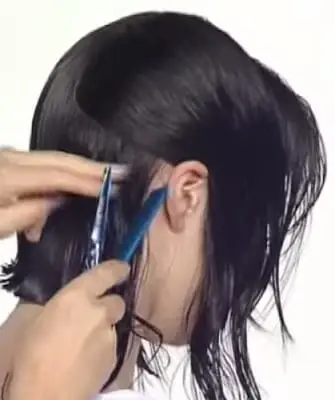
4 Before you cut the caret, trim the hair at the temples and crown.
With a comb, horizontally separate strands of hair and cut them with scissors, pulling them 10-15 °. The strands above should be shorter than the lower strands. For clarity, the difference in the length of the strands in the figure is overestimated.
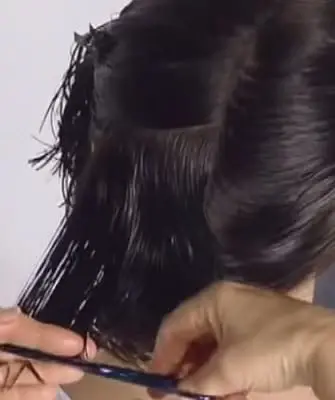
5 Having cut all the hair at the temples and crown, you need to check the edging, make thinning.
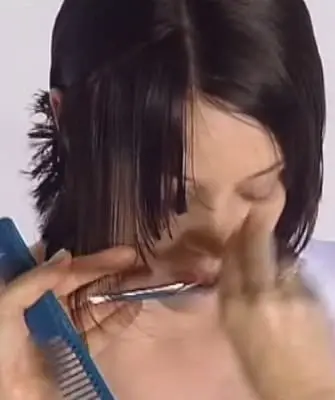
6 The symmetry of the caret with the ends of the hair bending upwards is defined as in the classic caret.
How to make an oval bob haircut
How an oval square is made is shown in the photographs.
1 Before you make an oval-shaped caret, you need to wash your hair and dry your hair a little with a hairdryer. Then divide them into two or four parts (depending on the thickness of the hair).
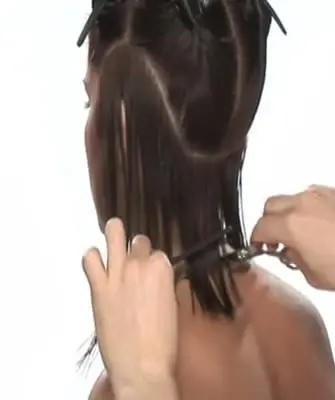
2 The technology of this hairstyle for medium hair resembles a classic bob. The difference in the oval square technique for medium hair and the “classic” technique is that the next strands to be cut should be longer than the previous ones.
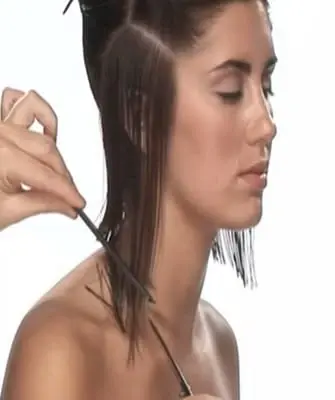
3 First, cut the occipital strand 1 cm thick.
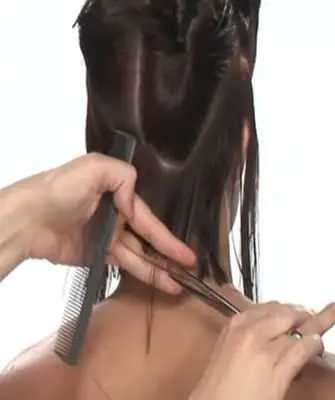
4 Next, cut the hair at the back of the head as in a classic bob, but the subsequent strands are left 1-2 mm longer.
5 Similarly cut the hair on the temples and crown.
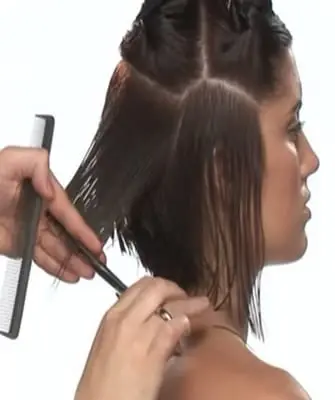
6 Check the symmetry of the haircut.
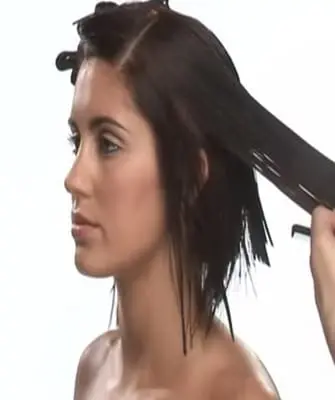
7 The final stage of how to make an oval-shaped bob haircut is thinning at a level of 1-1.5 cm from the ends of the hair using the slicing technique. This will make the hairstyle more perfect, and the hair will curl down beautifully and naturally, framing the front of the face with an oval.
Caret technique with graduation for medium hair
1 Wet clean hair. Depending on the thickness of the hair, collect them in one or two to four bunches so that they do not interfere with cutting the hair at the back of the head. Separate the occipital strand of hair with a horizontal parting.
2 Cut the occipital strand to the required length. She will be the control. All other hair should be leveled along it without a pull.
3 Next, separate the hair parallel to the control strand and cut it so that all the hair on the back of the head is the same length.
4 At the temples in the lower part, the hair is also cut in stages, separating them with horizontal partings. Hair is equal to the occipital strand. The parietal hair is still in the bun.
Further, a haircut can be performed in two ways.
1 Loosen the hair on the crown of the head and, in the course of hair growth, comb it over the face.
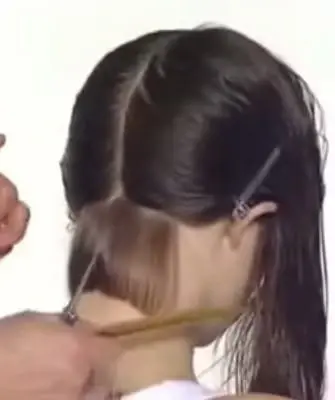
2 Mentally outline the line along which the hair will be cut. This will be the control section for the hair on the front of the head and crown. Usually bangs are left 6-8 cm long. Cut the first strand, separate the following strands with horizontal parallel partings and cut along the first (control) strand.
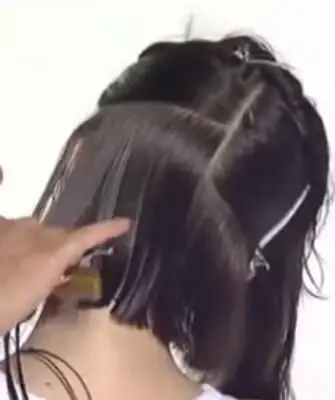
3 Next, cut the hair on the parietal and temporal parts of the head, pulling them with a comb to the control front strand.
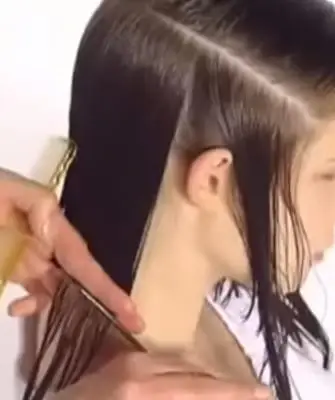
4 Cut the hair at the crown and nape in the same way – comb it up and align it with the control top strand.
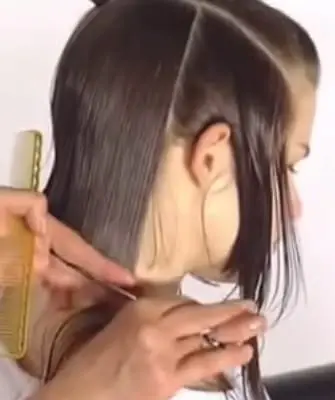
Next, comb the hair in the direction of hair growth and make a fringing, if necessary, trim the cut line of the hair from below. It should be even and clear.
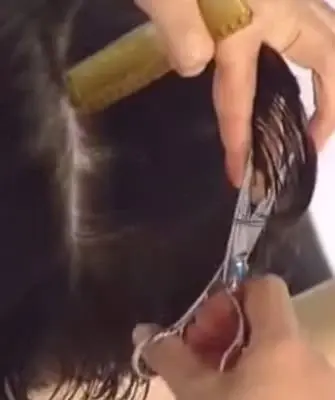
5 Thin out with straight scissors or apply the slicing technique.
These techniques should be used in front, behind, on the sides, on the bangs. With sparse hair, thinning can be done at the roots of the hair to add volume to the hairstyle. This is especially recommended to do on the back of the head.
How to cut an elegant classic bob
1 Wet clean hair.
2 Distribute the hair on the head into several parts: pin the parietal, two temporal strands and leave the hair free at the back of the head.
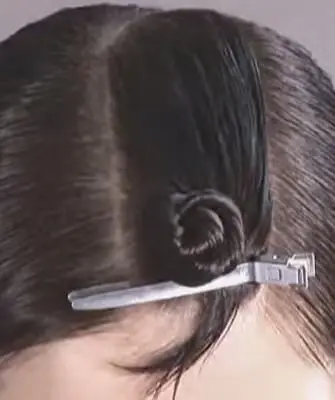
3 Proceed to the haircut, starting with the hair at the bottom of the back of the head. Separate strands of hair 1 cm thick with horizontal partings with a comb. For thick hair, strands should be made thinner – 0.5 cm each. Carefully comb each strand and cut horizontally with scissors, first in one direction and then in the other.
4 Having cut the hair at the back of the head, immediately perform pointing and continue to cut strand by strand.
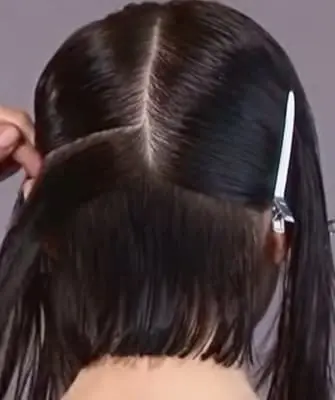
5 In the upper occipital and temporal parts of the head, the hair must be separated by vertical partings. Haircut to perform strand by strand, moving from the middle of the back of the head to the temples. Here, cut off the hair with a pull from the head at a right angle.
6 Cutting the hair directly at the temples, comb it towards the face and at the same time horizontally.
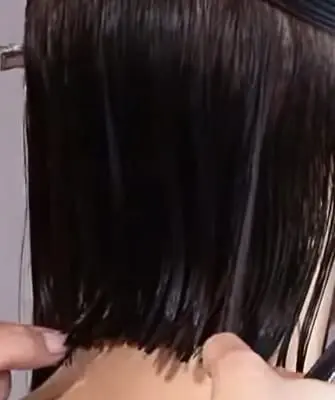
7 After that, comb the hair at the temples down and continue the caret line from the back of the head, and then work in the pointing technique.
8 Complete the haircut with an elegant classic bob, slicing at the temples.
9 Check the line of the caret all over the head.
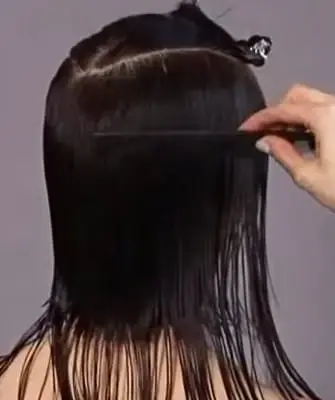
10 In the area of the bangs, separate with a comb strands 2.5-3 cm thick and cut them strand by strand. Then trim the bangs using the pointing technique, holding the hair in the bangs with a comb.
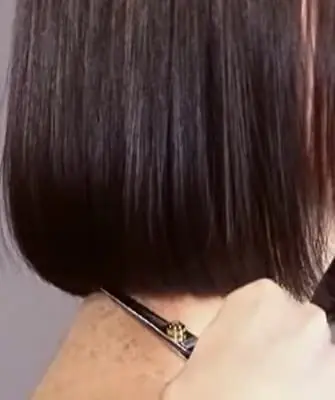
11 You can style your hair after this haircut in several ways. For example, lightly fluff the bangs and smooth the whiskey. Before drying, you can apply gel to the hair at the temples and then comb them with a comb with rare teeth.
Cascading haircut technique for medium hair
1 Wet clean hair.
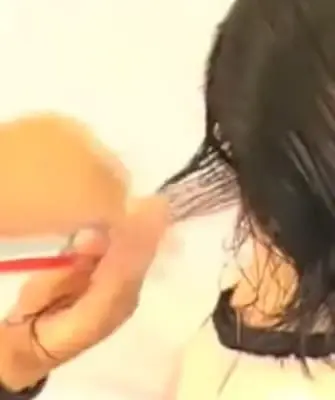
2 Divide your hair into several sections.
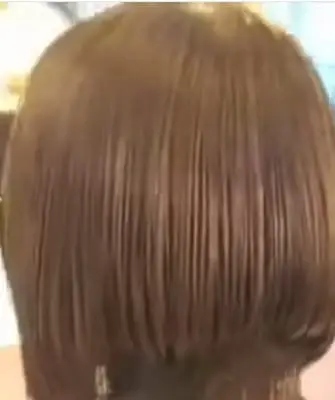
3 You need to start a haircut from the top. Select a strand of hair at the crown parallel to the forehead. She will be the control. Its thickness should be 1-1.5 cm. Raise the strand with a comb at a right angle to the head and cut to the desired length. The usual length of the control strand is 5-8 cm.
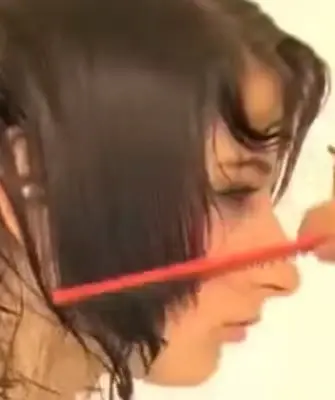
4 Comb the hair from the back of the head to the control strand and cut, leaving their ends at the same level.
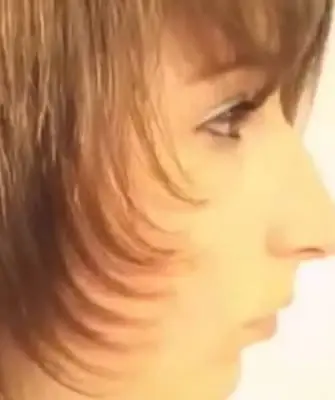
5 Cut the side (temporal) parts of the head in the same way. First, select the control strand with a horizontal parting, then comb the hair on it and cut it at the same level.
Technology of cascading hairstyles for medium hair
The technology of cascading hairstyles for medium hair provides two ways to perform.
First way:
The haircut of the frontal and parietal parts of the head is based on the control strand at the crown. Hair from the top of the head should be combed to the control strand at the crown and lifted at a right angle relative to the head. Thus, gradually move from the crown to the forehead, but at the same time focusing on the control strand.
Second way:
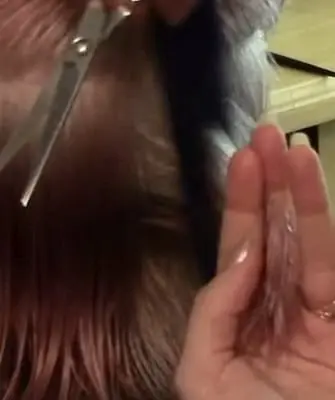
This method is recommended if you want to make your hair shorter in front. Move during the haircut from the control occipital strand to the crown.
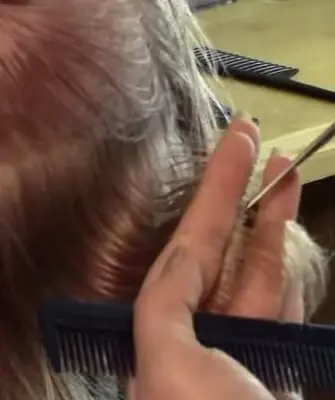
Then from the crown to the forehead. Raise the hair with a comb perpendicular to the head up. The previous strand is always a guideline for determining the cut line of the next strand.
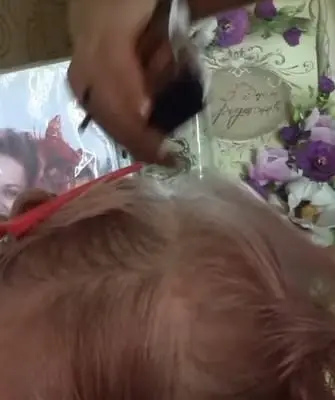
1 Comb all hair in the direction of hair growth. Front will turn out on the face. Trim them evenly, i.e., make a fringing hairstyle.
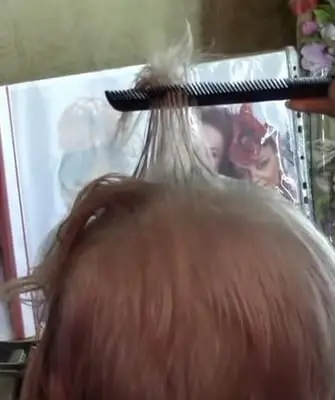
2 Once again, go through the comb all over the head and trim the stray hairs.
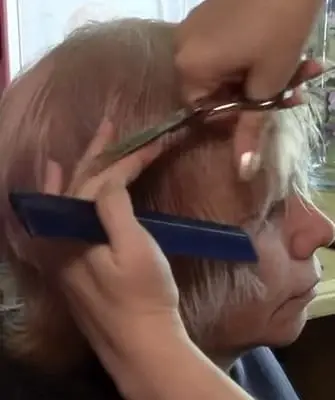
With straight hair, it is recommended to profile the hair on the head. You can use the slicing technique for this. With thin hair, a beautiful effect can be achieved by thinning at several levels – not far from the tips and at the roots of the hair.
Making a romantic hairstyle for medium hair
So, you have made a decision: “Making a hairstyle for medium hair!”, But you don't know which option to choose. We offer a romantic hairstyle that is suitable for creating a gentle, elegant look.

1 Wet clean hair with water.
2 Separate the hair in the bangs with a triangle. How close the top of the triangle will be located to the crown depends on the thickness of the hair. The base of the triangle should not extend beyond the depressions at the temples. Most often, the width of the bangs is the distance between the tubercles of the frontal bones.
3 At the temples, separate the hair with a parting that runs parallel to the direction of the hairline. Standing behind the client, cut these temporal strands of hair. Cut off the hair parallel to the border of the scalp at the temples.
4 In the region of the crown of the head, separate the hair with partings that run parallel to the sides of the triangle. Pull the hair at a right angle and, cutting it, repeat the outline of the line of the head.
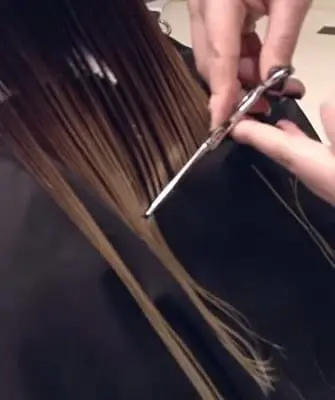
5 Cut the hair at the back of the head in the same way. You should start from the center, and cut your hair first in one direction and then in the other direction. Use the "strand by strand" method and cut the hair in a straight cut, in the palm of your hand. Do not leave hair at the back of the head longer than the middle of the neck.
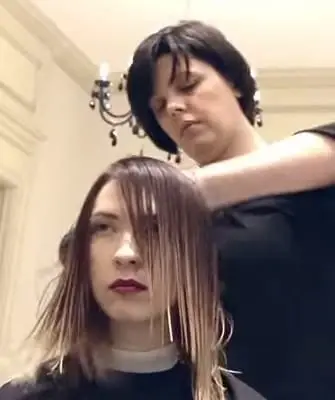
6 Then you need to go to the bangs. Dissolve the hair in a triangle, pull it down and twist it with a flagellum. Then cut the flagellum below the level of the intended bangs by 1-1.5 cm.
7 The transition from the bangs to the parietal part of the head must be done using the pointing technique. To the face, the hair should remain slightly longer than to the crown.
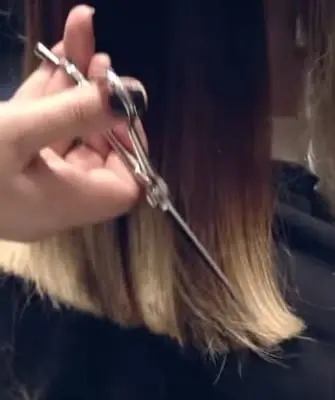
8 Then, with a razor, you need to complete the haircut. With quick movements of both hands, thin out with a razor. This will make your hair look lighter and more voluminous.