
How to deal with ingrown hair
Such an unpleasant phenomenon as an ingrown hair is, alas, familiar to many. Quite often, ingrown hair occurs after the removal of unwanted hair. Hair can grow in any part of the body: bikini area, legs, face, armpits. This is a rather painful and aesthetically unattractive phenomenon. Most often, this problem is faced by girls who carry out hair removal procedures at home. Of course, there are also cases when a problem occurs after procedures by a bad specialist.
What is an ingrown hair?
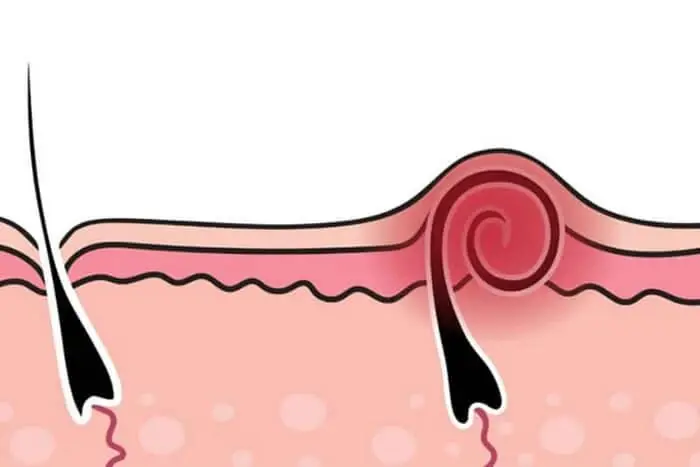
In normal hair growth, the tip is outside the skin. When this principle is violated, ingrowth occurs. The sharp edge of the hair begins to grow under the skin, which causes inflammation, itching, redness, and in some cases, suppuration. Hair growth continues, but occurs under the skin. If the problem is not eliminated, then infections may join and further inflammatory processes will become more widespread.
Why does hair grow?
Ingrown hair can occur for various reasons. So, among these, individual characteristics and improper preparatory measures before hair removal stand out. Personal characteristics that increase the risk of ingrown hairs include:
- the presence of coarse and dark hair on the body;
- curly hair.
Other factors that can cause ingrown hairs include:
- shaving on dry skin;
- not a sharp enough razor;
- shaving too hard
- plucking hair with wax or tweezers;
- too tight clothes.
Mostly ingrown hair causes depilation. Some of the hair may remain under the skin while the top is removed.
What can I do to prevent ingrown hair?
Make sure that underwear and clothes do not squeeze the skin too much. Tight underwear interferes with natural hair growth and leads to ingrown hairs. Most often, the problem occurs in the bikini area and on the legs, with the wrong selection of underwear and tights.
If you are removing hair by shaving, then it is imperative to prepare the skin. Pre-steaming in hot water will help. This will make the hair softer and allow the muscles to relax and also open up the pores. It is recommended to use an interlayer between the razor and the skin. Special creams, foams and shaving gels are well suited as this. It is also not recommended to shave against the direction of hair growth, to press too hard and to shave several times over the same area. If the hair is cut “under the root", then the probability of its ingrowth is very high.
Before waxing, it is also necessary to properly prepare the skin. It is necessary to treat the depilation area with an antiseptic. When removing hair with wax, it is important to observe the correct angle: when shaving, you need to remove hair according to hair growth, and when waxing against it. The movement of the hand should be strictly parallel to the skin. After it is necessary to degrease the area and apply a softening cream or lotion.
It will not be superfluous to take care of the skin with the help of special products that remove the keratinized layers. Scrubs and peels are suitable for this.
There is an easier way to deal with ingrown hairs – replacing depilation with epilation. Laser or photoepilation removes hair completely, leaving no part of it in the follicle. For this reason, ingrowth does not occur. This is a good alternative to waxing and shaving, which will get rid of ingrown hairs and make the skin really smooth.