

How to deal with ticks: protection and prevention of infections
Currently, bites by blood-sucking insects are recorded even within the city, for example, at a bus stop located in the shade of green trees. How to deal with ticks with improvised means? What kind of protection against ticks can be used? What is the prevention of tick-borne infections? You will learn about all this from this material.
Non-specific, or disinfectological, prevention aims to prevent ticks from being sucked. The principle "no suction – no infection" applies.
Every year, the website of the Research Institute of Disinfectology publishes an information letter about non-specific prevention of tick-borne infections, and above all about tick-borne viral encephalitis, tick-borne borreliosis, Crimean hemorrhagic fever (CHF), a severe infection that is common in the southern regions of the European part of Russia.
Tick protection for humans
1 Collective protection against ticks. This is an attempt to destroy ticks in open nature, to make the environment bio-safe.
2 Individual protection against adhesive for people – when a person protects himself from ticks.
3 Sanitary-educational work among the population.
Tick Prevention
Collective protection is protection against environmental mites. Currently, 17 acaricides are allowed to control ticks. Prevention from ticks is carried out in early spring. But, unfortunately, there is a problem that science cannot yet solve. For environmental reasons, in order to protect the environment, the use of pesticides with a long residual effect is prohibited. A specific example is DDT, which has been used in the past. One treatment with DDT made it possible to protect the territory from ticks for 7, 8, sometimes even 10 years. At present, these pesticides are prohibited, and only substances with a short residual effect, which very quickly decompose in the environment into harmless compounds, are allowed. It should be noted that the use of substances with a short residual effect cannot undermine the vector population. The fact, that these preparations are highly effective, but can only destroy active mites of the upper layer of the soil litter. But from below, from the deep layers of the litter, a new phase of mites crawls out.
Tick bite prevention
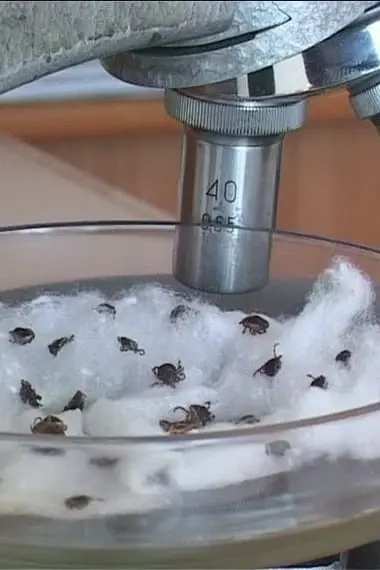
Collective protection is usually carried out by the disinfection service. Since 2019, 2 drugs have been approved for use in everyday life. They help prevent tick bites. Before using them, it is necessary to clarify the type and genus of mites, which determine the amount of acaricidal preparation needed to treat the area. It is necessary to know the genus of ticks, since the treatment of the territory varies, if, for example, on the site there are ticks of the genus Ixodes, which are the only carriers of tick-borne borreliosis and tick-borne encephalitis, and if on the site there are ticks of the genus Dermacentor, which are more resistant to acaricides. For ticks of the genus Dermacentor, higher consumption rates are applied, but they practically do not tolerate tick-borne encephalitis and borreliosis. When using any drug, you must carefully read the instructions and follow the safety requirements.
Tick protection
Individual protection is possible with the use of repellent (repellens – repellent), acaricidal agents and protective clothing.
Repellent means of protection against ticks are less effective than acaricidal ones. The most effective is special protective clothing, which for technological reasons could not appear earlier. Currently, 28 acaricidal sprays for clothing and 26 insect repellents are authorized. All repellents are based on the use of diethyltoluamide. This substance was discovered in 1950, and despite the great efforts of the whole world, no more effective repellents have been found. Unfortunately, both repellent and acaricidal agents are unacceptable for CCHF vectors – large, fast-moving ticks, against which personal protective equipment is not yet available.
Special clothing: Currently it is the Biostop suit. Now a number of other clothing options are being tested, but only this suit received a positive assessment from the Disinfectology Research Institute.
Prevention of tick-borne infections
New acaricides, in whose chemical formula a cyano group is introduced, have a pronounced effect on mites. When in contact with these compounds, the tick does not have an avoidance reaction, it does not feel danger. The tick crawls onto the treated tissue, and it very quickly begins to disrupt the conduction of nerve impulses, paralysis occurs, primarily of the suction organs, and soon the tick falls off and dies. The action of the acaricidal drug develops within a few minutes. This is the most effective prevention of tick-borne infections.
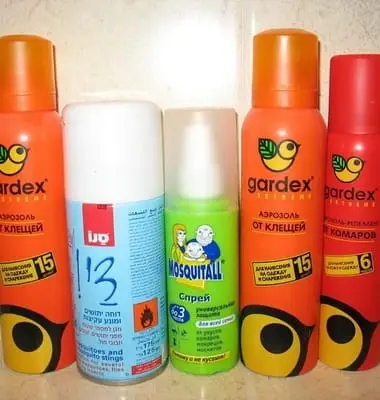
Acaricidal preparations should be used to treat clothing, also because of their toxicity. They can only be applied to clothing. Please note: ticks attack children and adults in different places, if in adults it is the lower leg, thigh, then in children of small stature, in this case, there may be a chest level. This must be taken into account when processing clothes.