
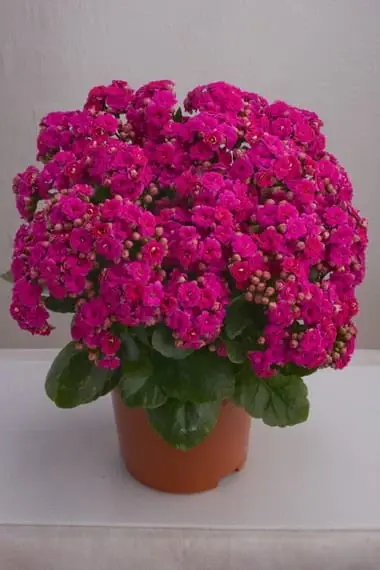
Indoor plant Kalanchoe: photo, medicinal properties of the Kalanchoe flower, description of the types of home plants
Many types of Kalanchoe flowers are included in succulent collections or placed on small stands in home greenhouses. These plants are very easy to propagate and, in addition, they do not require special conditions.
Description of the types of houseplant Kalanchoe
The houseplant Kalanchoe, like aloe, has until recently been popular primarily for its medicinal uses. Therefore, two species are considered the most famous and common in the genus.
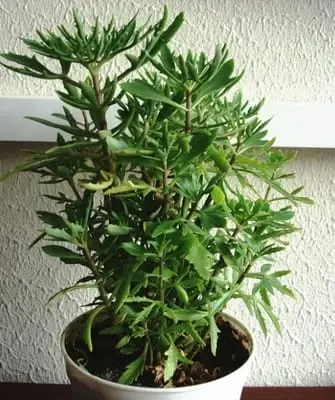
In the treatment of various diseases, the leaves of indoor Kalanchoe pinnate K. pinnata (pinnata) are used. It is sometimes called the "tree of life" or "room ginseng." This species, together with another widespread Kalanchoe degremontiana (K. daigremontiana), is often referred to as a separate genus bryophyllum (Bryophyllum). These plants are kept indoors mainly for two reasons: their medicinal use and the extreme ease of growing and propagating them.
However, now decorative species and varieties of Kalanchoe, of course, have come to the fore in room culture.
The diversity of this vast genus – more than 200 species – naturally, is not limited to two types that are popular in rooms. Among the undemanding and fast-growing Kalanchoe, there are many decorative forms with a fantastic shape and leaf color. Some of them tolerate shade well and are therefore used for interior decoration.
As shown in the photo, medium-sized Kalanchoe plants are suitable for window sills and for inclusion in a succulent collection:
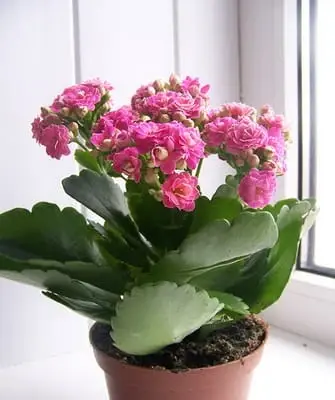
When describing the Kalanchoe flower, two species should be especially noted – K. blossfeldiana (blossfeldiana) and K. manginii (mangini), which are grown in pot culture because of the beautiful flowering.
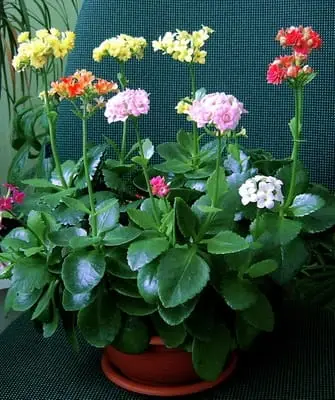
Both plants have wide, fleshy leaves in compact bushes, on which many flowers appear on tall peduncles in spring. K.blossfeldiana has 20-50 tubular scarlet flowers with a diameter of not more than 1 cm in inflorescence, and k. manginii has up to 15 larger ones – about 3 cm – red flowers that have the shape of a drooping bell. On the basis of these two species, many profusely flowering varieties have been bred with a diverse bush structure and leaf shape, with bizarre flowers in color and structure.
Medicinal properties and care of the Kalanchoe home plant
For medicinal purposes, Kalanchoe pinnate is especially often used. Its leaves are cut and placed in a dark, cool place for a week. After that, they need to be crushed and squeezed out the juice. The beneficial properties of the Kalanchoe plant are due to the fact that its juice contains flavonoids, tannins, various organic acids and polysaccharides, micro and macro elements. Due to this, it has an anti-inflammatory, bactericidal, healing and hemostatic effect. Juice is used for lotions or ointments are prepared based on it. Also, the medicinal properties of the Kalanchoe plant are used for a cold and for the prevention of influenza: the juice is instilled two drops into each nostril twice a day. With tuberculosis, the juice is taken orally.
The optimal conditions for growing Kalanchoe are a loose nutrient soil mixture, abundant watering from spring to autumn, and good lighting. They feel good with a fairly warm wintering (13-16 ° C). When caring for a Kalanchoe home plant, periodic watering is necessary to prevent shedding of leaves.
When kept indoors, these plants quickly stretch out, and they need to be constantly rejuvenated, since this is not difficult to do: they easily and quickly grow from cuttings that are born on the leaves of young rosettes with roots (the phenomenon of the so-called live birth) and from seeds. Kalanchoes reproduce so easily indoors that they can become a real weed for other potted plants.