
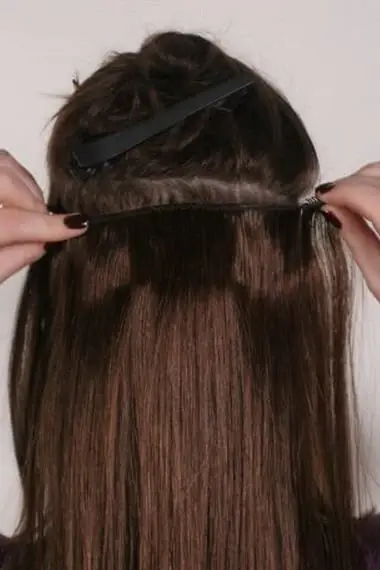
Natural false hair: photo of false bangs, parietal lining, how much they cost and how to attach the lining
However, if you lose your own hair, you can't do without overheads, especially when it comes to women. There are not so few types of false hair, so depending on your needs, you can always choose the right ones. Some need a crown cap to cover the absence of hair on the back of the head. Others need false bangs to mask the frontal bald patches. There are hair extensions and half-wigs for other parts of the head.
How much do hair extensions cost, what hair extensions look like in the photo, how to attach them and how to care for them, you will learn on this page.
Despite the rapid growth of chemistry throughout the 20th century, despite the invention of high-tech materials, to this day chemists and technologists have not been able to create an artificial or synthetic fiber that could become a full-fledged replacement for human hair. In terms of richness of shades, barely noticeable shine and pleasant silkiness, natural hair, like many years ago, is not inferior to any artificial material in the world. Since there are very few people who want to part with the wealth inherited from nature, the price of products made from natural hair, whether simple pieces or whole wigs, is an order of magnitude higher than similar products made from artificial or synthetic material.
How much do natural hair extensions cost
Unlike chemical fiber, which is produced in tons in factories, products made from natural hair are always piece-by-piece and are produced in small batches. This, in turn, also raises the price of the finished product. It is the high price today that is the most significant drawback of this type of false hair. A quality cheap synthetic wig costs about $100, while canicalon wigs can be purchased for $200-250. Similar natural hair products cost from $300 to $1,000 depending on the type of hair attachment on the base.
Preparation of natural hair for making wigs
Before manufacturing, all natural hair is carefully prepared: at the first stage, they are sorted by thickness and length. At the same stage, a partial rejection of weakened, split and dyed hair takes place. Then the preparation of natural hair for the manufacture of wigs consists in the most thorough disinfection in a soap and soda solution.
After drying, healthy strong hair is dyed in the required colors, weak and thin hair is left without additional staining. At the final stage, the hair is polished, giving it additional elasticity, after which the hair of the same type in structure is used for the production of finished products.
Hair extensions – half wigs and their photos
Today, overlays remain the most popular type of alternative hair. If the wig involves a complete replacement of the hairstyle, and the chignon is used to give the hair additional volume in the back of the head, then the pads are used for a variety of purposes and are attached to any part of the head.
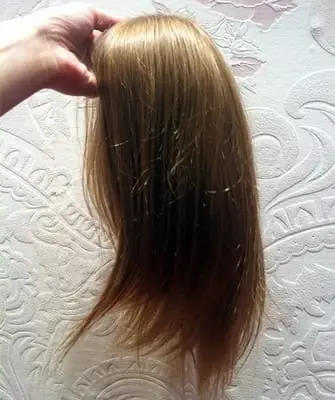
The most voluminous type of overlays is a semi-wig. This type is used to increase the volume of one's own hair at the crown and in the back of the head: it is in these places that the first bald patches most often appear or the hair thins greatly.
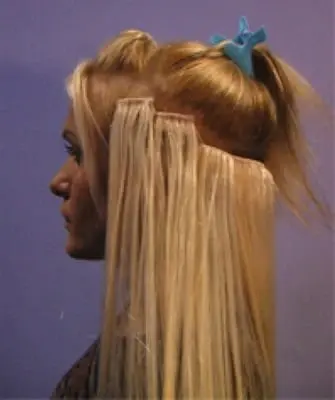
And if hairpieces adorn, first of all, a woman's head, then half-wigs are worn with equal success by both ladies and men, who are concerned about the appearance of bald patches.
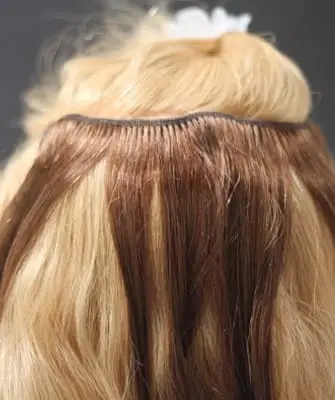
Look at the photo: hair extensions in the form of semi-wigs are thin strands of hair fixed on a base:
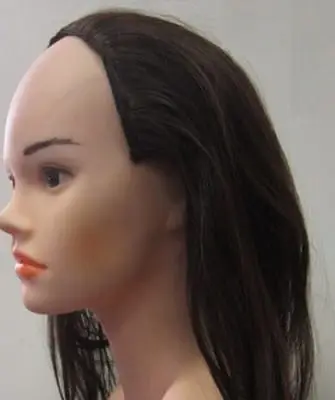
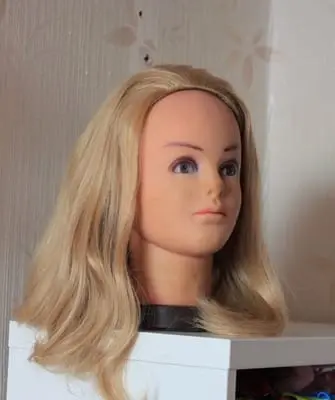
Unlike wigs, this type of false hair leaves the frontal part of the head open and is attached to the parietal part, allowing you to increase the volume on the crown, as well as on the back of the head, where additional volume is often required to create hairstyles.
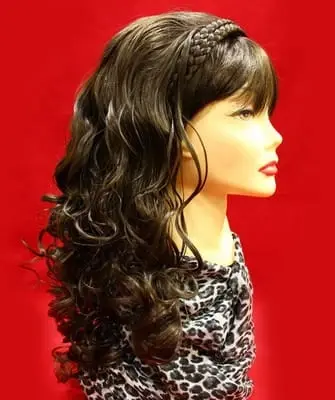
Like all types of false hair, semi-wigs are made from natural hair and its substitutes. But since half wigs leave part of your own hair exposed, it is important to choose the hair extensions with the same texture as your own when choosing a wig.
Half wigs based on mesh or lace
Recently, new types of overlays have appeared to give extra volume to the hair: semi-wigs based on mesh or lace with a large number of holes, also called gossamer overlays, which allow you to intertwine false hair with your own.
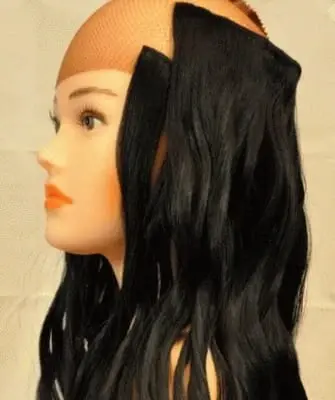
Such a semi-wig is applied to the hair, after which their own hair is pulled through the holes to the outside. When using such an overlay, your own hair is mixed with overheads, and the overlay becomes completely invisible.
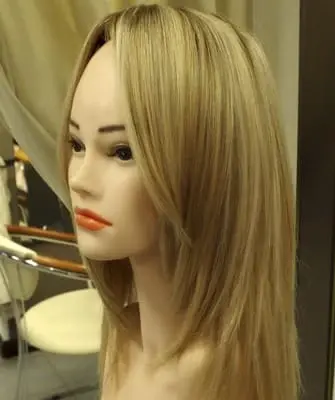
Unlike classic half wigs, the color of these types of overlays does not have to match their own color. When using false hair of a lighter shade, when mixed with your own, you will get a highlighting effect that never goes out of fashion, and strands of a darker shade will give the hair a coloring effect.
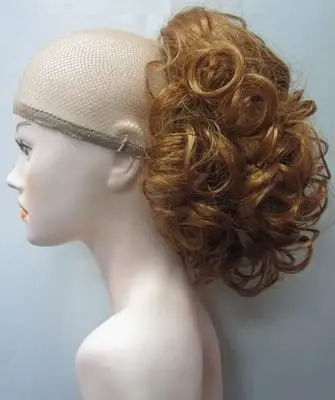
However, in order for the hair of such a cobweb to look natural, the structure of the hair should be as similar as possible to its own: for thin hair – with thin elastic hair, for hard hair – with hard thick hair.
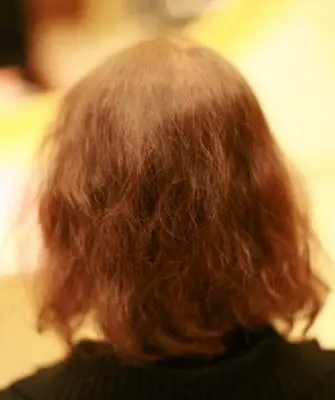
This hair extension system is one of the latest developments and is effectively used both to increase the volume of the hairstyle and to hide the problem areas of the scalp. The advantage of such overlays, in addition to the visual cosmetic effect, is convenience: the hair extension system allows you not to touch the false hair for 25-30 days after installation, after which the procedure must be repeated.
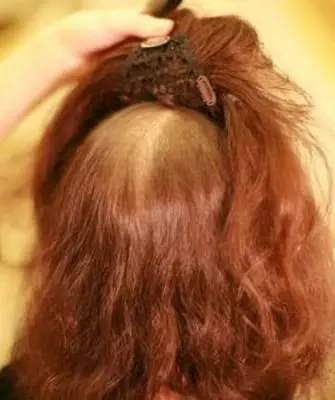
The main disadvantage of the gossamer patch is that it takes a lot of time and specialist assistance to install it, and your own hair, with constant reinstallation and constant tension in the patch area, can be injured and fall out.
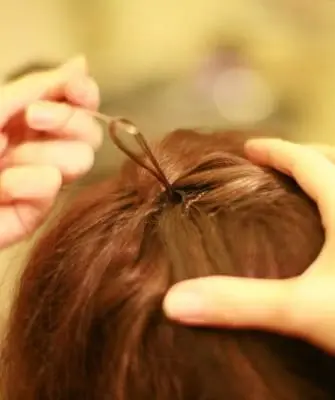
The specificity of the use of cobweb and integrated overlays requires their constant wear, therefore they are most often used as an alternative to hair transplantation, to achieve a short-term effect: when creating a new hairstyle, simply increasing the volume or length of the hair, other types of overlays are used on standard attachment methods: “crabs ", ribbons, hoops.
Hair extensions on the parietal part of the head
When selecting a parietal lining to hide the baldness in the crown part, the lining is made in the form of a balding area of the head, but larger. As a basis, a very thin material imitating the scalp is used, most often a specially developed polymer composition.
Such an overlay can be glued to the problem area with a special surgical glue that is harmless to the skin, or attached to the head by one's own hair in neighboring areas with special miniature clips, and also attached to the scalp with a special double-sided adhesive tape.
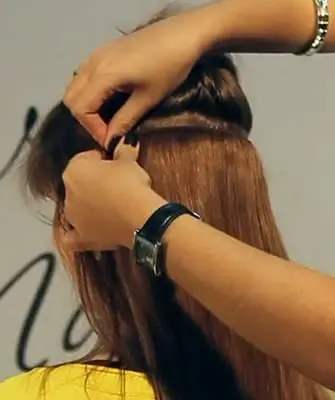
All these methods allow you to securely fix the patch and wear it for a long time, without spending effort on everyday fixing of false hair in the problem area. Properly selected parietal pad completely merges with your own hair.
False bangs made of natural hair and kanekalon
Another very popular lately type of artificial overlays is bangs. Modern fashion is extremely dynamic and constantly dictates the change of images and image. What is worn today may be out of date in a couple of months, and hairstyles recommended for offices may not fit in with the look needed for going to a youth party.
Own hair does not always cope with the overwhelming demands of capricious fashion, it can take years to grow a lush bang, while the shape of the bangs, its color, and the degree of splendor change every month. The once popular asymmetrical bangs are replaced by a straight line, like a ruler; lush and long, covering the eyebrows, replaces thinned and short.
In addition to fashion trends, bangs are often required not so much for a new look, but for correcting cosmetic defects of the face: too large temporal bald patches, a high forehead and other nuances of appearance. Own hair is far from always able to cope with this task, it may not be thick enough to cover a bald patch, or the hair structure is too thin to make a lush bang.
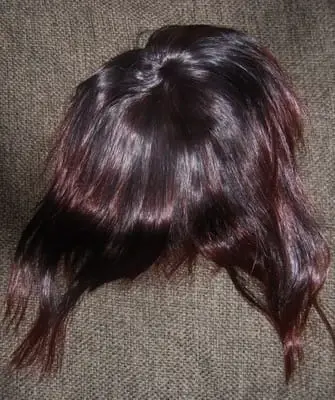
In all these cases, you can use false bangs, which today are produced both from natural hair and a high-quality analogue – kanekalon.
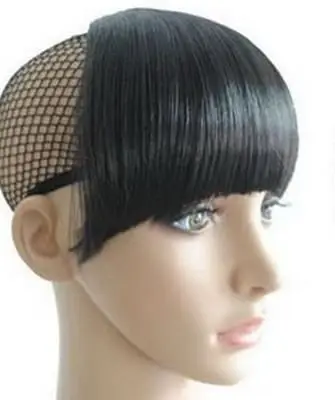
As you can see in the photo, the false bangs in their structure are a variant of the lining, in which several rows of hair strands are sewn to a fabric or non-woven base:
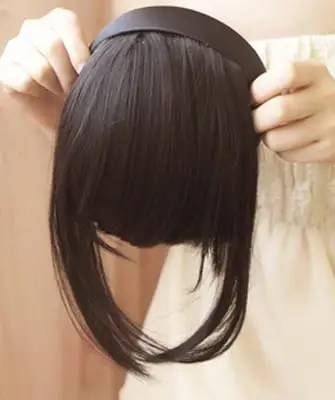
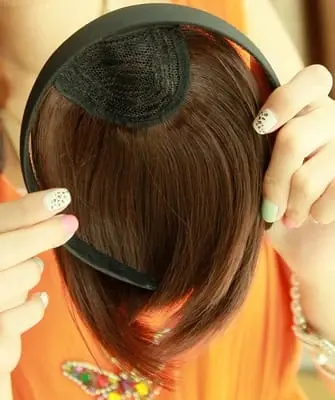
A fastener is located on the wrong side of the base of the bangs. The bangs on the hoops are a finished rim or hoop, to the front of which one side of the lining base is attached.
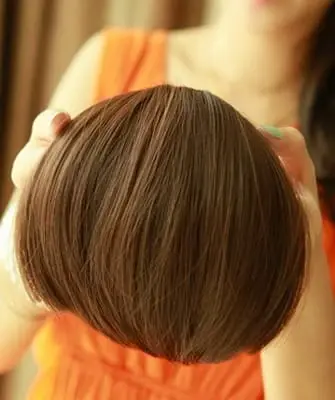
Since bangs should not differ from your own hair in structure and color, this type of overlay is practically not produced from cheap synthetic fibers: nylon or acrylic.
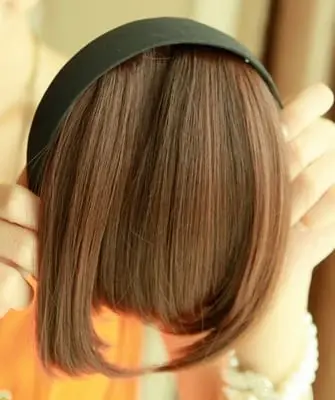
Depending on fashion trends, in the market of hairdressing accessories you can find torn bangs and bangs of strict geometric shapes, lush and medium in volume, straight and asymmetrical. According to the method of attachment, bangs are divided into overlays on rims (hoops), clips (hairpins) and ribbons.
How to attach false bangs on the rim
False bangs on the rims are produced in a variety of shapes and lengths. Most often they are used to increase or shorten the length of your own bangs, or to hide the defects of an unsuccessful haircut, they are also suitable if you don’t have your own bangs, but you want to change your image.
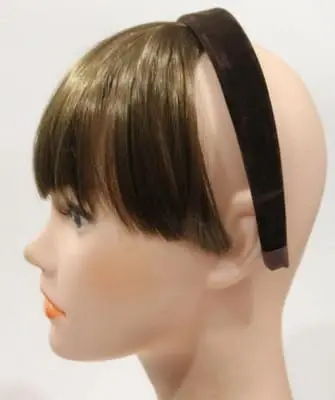
In addition, lush bangs on hoops are used to hide frontal or temporal bald patches. The most important advantage of such a bang is the speed and simplicity of hair extensions, since to fix it, you just need to put a hoop over your own hair.
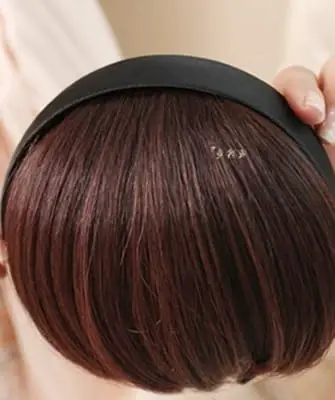
If you don’t know how to fix a false bang on the headband, you will be pleasantly surprised – this type of lining does not require special fixing on the hair, as well as masking the attachment point with your own hair and can be considered one of the fastest ways to change hairstyles. Outwardly, with the right choice of color and structure of the hair, everything looks as if they put a hoop on their own hair with bangs.
How to attach hair clips
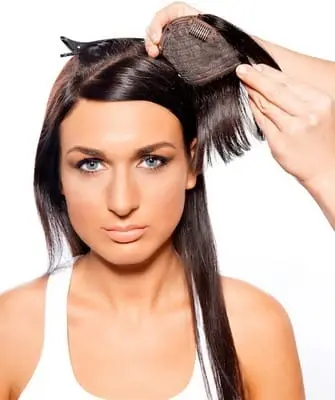
As you can see in the photo, clip-on hair extensions are a little more complicated and require preliminary preparation, as they are attached to your own hair:
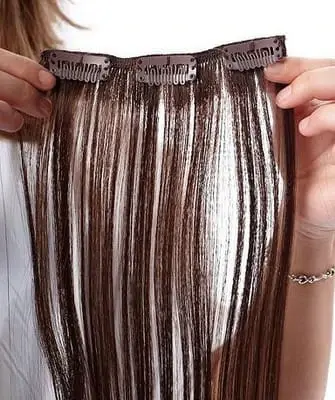
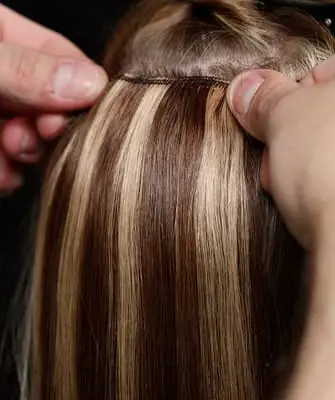
Before attaching false hair, it is necessary to make a parting at the attachment point, lightly comb your own hair, to which the bangs will be attached, then the clip will securely fix the overlay, and then attach the overlay clip to your hair.
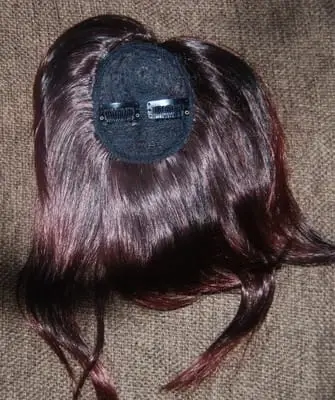
If you have your own bangs, the patch can be attached under the hair and the attachment point can be masked with the upper part of your bangs; if it is absent, the patch can be fixed over the hair. In this case, when attaching the bangs, you need to ensure that the clip is not visible later.
Caring for false hair at home
Caring for false hair at home is generally the same for bangs, hairpieces and semi-wigs. Synthetic hair is washed with special shampoos and balms, and for natural hair, a mild shampoo is used according to the type of hair. During storage, the bangs are laid out on a horizontal surface, straightening the hair so that they do not wrinkle.