

A set of breathing exercises: what are and how to do breathing exercises with a disease of the respiratory system
The simplest set of breathing exercises can be mastered in a few lessons. Depending on the degree of preparation of the body, the assimilation of the technique of proper breathing will take from one to three weeks for different people. A set of exercises for breathing exercises includes several basic techniques – start with them. Below is a description of what breathing exercises are and recommendations for their correct implementation.
Thanks to the work of the respiratory organs, our body is enriched with oxygen, cleansed and functions normally. Functions of the respiratory system: breathing and gas exchange, thermoregulation, air humidification, protection from environmental influences. Lung tissue is involved in water-salt and lipid metabolism, in the synthesis of hormones, it stores the reserve part of the blood.
What are the types of breathing exercises
A set of breathing exercises helps to strengthen the respiratory apparatus, intensify the purification process and metabolism, increase the vital capacity of the lungs, and increase the flexibility of the thoracic spine. If you learn how to do breathing exercises, you can ease the course of fasting and reduce the symptoms of acidosis.
The most famous types of breathing exercises are described in the methodology of K. P. Buteyko, A. N. Strelnikova, as well as in the bodyflex, oxysize systems, etc.
With proper breathing, a person breathes through the nose, calmly and rhythmically, the exhalation is slightly longer than the inhalation. People with cardiovascular pathology, asthma, obesity, and the elderly are especially affected by improper breathing.
A set of exercises for diseases of the respiratory system
Below is a set of breathing exercises with a description of exercises according to the Chinese method:
Wave exercise. Take a position lying on your back, bend your legs at the knees, put your feet straight. Take a slow deep breath, while drawing in the stomach and lifting the chest. Hold your breath for a few seconds, exhale. As you exhale, draw in the chest, stick out the stomach. Breathe smoothly, at a normal rate. Repeat the inhale-exhale cycle several times. The exercise can be done sitting or standing.
Exercise "Frog". Sit on a low chair with your feet shoulder-width apart. The lower leg and thigh form a right angle. Put your elbows on your knees, clench your left hand into a fist (men – right), grab it with your right hand. Rest your forehead on your fist, close your eyes. Fill your belly completely with air, alternating inhalations and exhalations through your nose and mouth. Hold your breath for 2-5 seconds.
Exercise "Lotus". Starting position, as in the previous exercise. You can do the exercise by taking the lotus position (sitting with knees bent and legs crossed). The back is straightened, the chin is slightly lowered, the eyes are closed. Place your hands in front of your belly with your palms up. Women put their left hand on top of their right in front of them, men – vice versa. The exercise consists of 3 parts.
1 part. Conscious breathing. Concentrate on breathing, breathe deeply, but do not raise your chest and stomach too high.
2 part. Focus on getting calm, quiet, deep breaths, relaxing completely on the exhale.
Perform parts 1 and 2 of the exercise up to 5 minutes.
3 part. Up to 10 minutes to breathe at a normal pace, in a relaxed, peaceful state, pushing out extraneous thoughts. Can be combined with meditation.
Exercises regulate metabolism, improve blood circulation, help relieve nervous tension, lose weight, and strengthen the muscular corset.
If dizziness appears during exercise, you need to pause, rest. Resuming the lesson, reduce the depth and rhythm of breaths. You can not do breathing exercises for people with organic heart disease, blood diseases, increased intracranial and ocular pressure, retinal detachment, pneumonia, chronic otitis media, cholelithiasis and urolithiasis, pregnant women, with multiple sclerosis, parkinsonism. With caution, you need to treat breathing exercises in childhood and old age, the exercises should be selected by a specialist.
Breathing exercises of yogis: a description of a set of yoga exercises
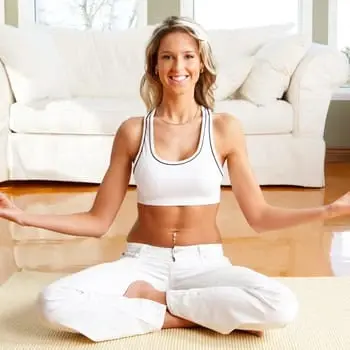 Speaking about what breathing exercises are, one cannot help but recall the exercises of yoga breathing exercises – many consider this complex the most progressive. According to the teachings of yogis, there are four types of breathing: clavicular (upper), chest (middle), abdominal (lower) and full, combining the three previous types. Performing a set of exercises in case of a disease of the respiratory system, all lobes of the lungs are involved: lower, middle and upper, the lungs are completely filled with air.
Pranayama – yoga breathing exercises normalize blood pressure, the work of the respiratory system, digestion. A set of exercises for the respiratory system can be done standing, sitting. Each exercise begins with inhalation through the nose and ends with exhalation through the nose or mouth.
Abdominal breathing. Inhale, shoulders and chest remain motionless, the abdomen inflates, the diaphragm goes down. Air fills the lower parts of the lungs. The exhalation is free, the stomach is retracted.
Chest breathing. Inhale, the abdomen and shoulders are motionless, the chest expands. Air fills mainly the middle of the lungs. The exhalation is free, the chest is compressed.
Clavicular breathing. Inhale, the stomach and chest are motionless, the shoulders rise, the head deviates slightly back. Air fills mainly the upper sections of the lungs. Exhale with head tilted forward and shoulders lowered.
Full breath. On inspiration, we stick out the stomach, the diaphragm goes down, then we expand the chest, raise our shoulders and tilt our head back a little. Exhaling, first we draw in the stomach, the diaphragm rises, we compress the chest, lower the head and shoulders.